
Transformative Money
...why you are not being paid enough and now is the time to change it

Technological change is neither additive nor subtractive. It is ecological. I mean “ecological” in the same sense as the word is used by environmental scientists. One significant change generates total change.
- Neil Postman, Technopoly: The Surrender of Culture to Technology
If you’re like most people on this planet, you have a problem: You’re not being paid enough for your work… even if you think you are. It doesn’t have to be this way. Imagine a world where your relationship with money is not a struggle, where you can reliably save the fruits of your labor without being an investment professional and where you can transact with others without barriers and transaction costs. Where one technology transforms your relationship with money to feel organic and ecological. We’re at the precipice of that world and you can be part of the transformation. Let me explain by going into…
The underlying causes of our struggle with money
A transformative solution to address these causes
Ways in which you can participate in the transformation
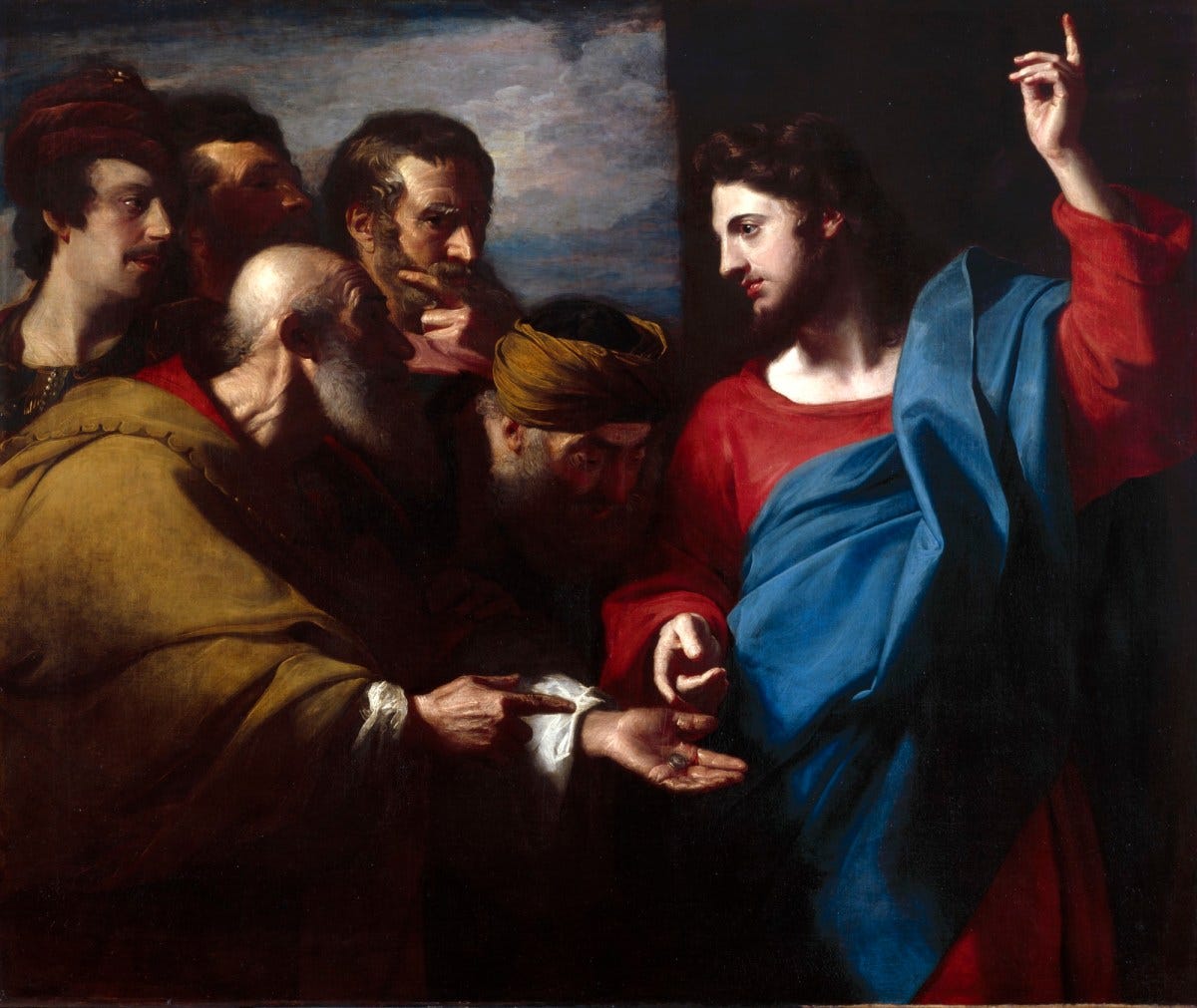
1) The Causes
“But Zacchaeus stood up and said to the Lord, ‘Look, Lord! Here and now I give half of my possessions to the poor, and if I have cheated anybody out of anything, I will pay back four times the amount.’” (Luke 19).
I invite you to join me in trying to understand why we’re not being paid enough, are spending more than is necessary and are often miserable about it. For simplicity we’ll focus on three causes:
Price: Our mechanism for finding the correct price for products and services and above all YOUR WORK is broken. As a result, you’re 1) probably not being paid enough for your work, 2) paying too much for products and services and 3) being incentivized to do work you’re not meant to be doing.
Intermediaries: Those who stand between your work and the fruits of your labor, i.e. either 1) companies that are taking part of your share while adding only limited value (e.g. global payments companies, banks, global tech/ads empires) or 2) people in your company that are just there to “manage” because our corporate hierarchies demand this. They get paid a lot but are hardly adding any value to the final product or service.
Attention economy/mimetic desire: Our economy abstracts us from our work and its products. The issue here is not capitalism, the issue is that we have been suckered into a paradigm where we are constantly paying with our attention without realizing it.
Let’s think a little bit more deeply about why each of the above is true.
Why price is broken
40 years ago the average American household had one breadwinner and could afford a comfortable life. Today, in the average American household both partners work and can hardly make ends meet. The reason for this is that prices were slowly but gradually corrupted by Western governments and central banks over the last 50 years. By printing money to try and solve every problem under the moon, central banks have imposed a hidden tax on all of us in order to support ever more bloated budgets. The cantillon effect has ensured that the share in the printed money has not been distributed equally but primarily among those closest to the money tap resulting in the financialization of our economy. Everyone else has been gradually debased, meaning you can afford less and less with your money.
More crucially incentives to to do real, honest work have been perverted. Teachers, nurses or skilled craftsmen are the backbone of our society and yet do not get rewarded appropriately. Instead everyone is incentivized to get as close to the money tap as possible: our most ambitious graduates want to go into investment banking, consulting, private equity or venture capital. I’m not denying that these jobs provide value to our society but their compensation stands in no relation to their relative importance. Think about this for a second. There’s no reason it has to be this way. Our money is broken.
How intermediaries take more than their fair share
When you pay for a product and service, a significant percentage of the transaction value is captured by the credit card company (Visa, Mastercard etc.) and payment processors (Square, Stripe, PayPal). However, the intermediation occurring between you, the buyer and the creator of the product is more profound than that. In order to reach you they have to pay advertising dollars to the big tech/advertising empires (Google, Meta) and you need to use banks to manage the flow of money, paying a hefty (often hidden) fee in the process.
In other words, the products you consume and enjoy could be significantly cheaper if we could disintermediate many of these unnecessary middlemen. The internet has started to accelerate this process by removing retailers as intermediaries from many transactions but there is more work to be done.
How the attention economy produces mimetic desire
The attention economy where we’re using services like Google, Facebook, Instagram or TikTok for free means that WE are the product. These companies are selling our attention and while we’re often not fully aware of it, we’re paying the price for it every single day. These companies have gotten so good at generating mimetic desire, that we’re constantly wanting and buying things that we don’t actually need. In other words, the reason a lot of people can’t afford to buy the things they actually want and need is that they are stuck in the hedonic treadmill of buying things they don’t need. And everything you need has gotten more expensive because companies trying to sell it to you need to pay what is essentially a small revenue share to the above advertising companies in order to reach you.
It’s not malice, but an ecosystem of inefficiency
Think about your life or work for a moment and think about how each of the three above points apply to you.
I want to be very clear: Most of the described dynamics are (for the most part) NOT a result of malice on behalf of any of the actors:
Central bank leaders, for the most part, did not have bad intentions when they found themselves continuously lowering interest rates and providing quantitative easing over the last 50 years, their hands were often forced by an overarching dynamic, e.g. governments that needed money to fight wars or fund other deficit spending.
Visa, Mastercard, PayPal and Stripe brought groundbreaking innovation to how we pay and they were royally rewarded for it. But they built these technologies on top of an antiquated system which is now being replaced and which will never be able to compete with the new technology that has arrived.
Big tech companies were not created with the goal of feeding the attention economy , but often with great intentions. Google’s mission of organizing the world’s information feels like something they are genuinely aiming for to this day thereby driving a lot of value for users of their products. It’s just that the business model is broken and creating a lot of unnecessary collateral damage.
2) The Solution
Then render to Caesar the things that are Caesar’s; and to God the things that are God’s” (Matthew 22).
What if I told you that there is a relatively new technology that will help you and everyone else overcome all three of these challenges? This technology is Bitcoin in conjunction with the Bitcoin Lightning Network.
“Here we go again…”, you’re probably thinking to yourself.
But if you agree that our three key problems above are real, I invite you to at least think for a second about what Bitcoin is and whether it might help resolve each of these problems.
What is Bitcoin fundamentally beyond the hype on the one side and the hysteria on the other? Fundamentally, Bitcoin is a new technology for money just like the telephone was a new technology for communication. And like the telephone which was better at almost everything than the telegraph, Bitcoin is better at almost everything than the money we know. Let’s look at the core characteristics of money to prove this:
Store of value: As we saw above, our money by its very design does not store value over time. In school we’re told that central banks have a mandate to aim for 2% inflation. I have always wondered why that is. The answer is that governments need this inflation (and we’re lucky if it’s just 2%) to fund their spending. And they’re diluting your savings in the process. With Bitcoin, governments don’t have the ability to do this, as its supply is fixed at 21 million. Therefore, over time, it will always be a better store of value than our existing government issued money.
Medium of exchange: Our existing money seems to work reasonably well as a medium of exchange, after all we can pay for most things relatively frictionlessly. This is true, but what’s also true is that you and the merchant you’re exchanging with are paying a huge hidden tax (credit card fees, bank fees, exchange rates etc.) for using Dollars. With Bitcoin (and the Lightning network), the fee is approaching 0. Bitcoin is native to the internet, transactions are peer-to-peer and there are no intermediaries, therefore very low fees are possible.
Unit of account: Our money is a pretty good unit of account, however Bitcoin is better. Because its smallest unit (1 Satoshi) currently has a much smaller value than the smallest unit of our currencies (e.g. 1 cent) and because transaction fees are negligible, Bitcoin lends itself to micro-transactions. This means you can pay very little for services that would otherwise have no market. When someone posts something insightful on social media, instead of paying with your attention, you could make a direct (sub-1 cent) payment to the author of that post. A lot of small payments would aggregate to a real income for those that provide value.
Like most new technologies, Bitcoin is better at pretty much everything than the incumbent, our government issued money. If an alien species came to earth tomorrow and we showed them government issued money and Bitcoin, they would choose Bitcoin every time.
There is no need to speculate here. You can go online and try for yourself. You’ll see that Bitcoin
allows you to send value around the world basically for free and instantly,
is limited to 21 Million and they are being audited every 10 minutes,
needs no intermediaries when you transfer it to a friend or stranger.
The speed, transparency and hardness of Bitcoin are unmatched by every other form of money. If we allow this technology to thrive, the effects on our economy and lives would be transformative.
If you’re still skeptical, I want you to know that almost everyone who has been convinced of the above over the last 14 years was initially skeptical as well. I certainly was. I thought Bitcoin was useless at best and a scam at worst.
What is currently still preventing Bitcoin from fulfilling its promise (like so many other new technologies in their early days) is friction imposed by the incumbents. And Bitcoin faces greater friction than arguably any other new technology before it because money is so central to our economic and social lives. Many livelihoods and powerful actors depend on the old system to make a very comfortable living. More than that, it’s government power itself that is at stake here. After all, war and deficit spending are inconceivable without control of the money supply (Vietnam war & Bretton Woods link).
It is when someone from a government agency or the traditional financial system is trying to convince you that Bitcoin does not work, that you SHOULD be skeptical. Jerome Powell or Jamie Dimon telling you that Bitcoin is not good money is like Western Union claiming that the telephone is not a useful communication device anno 1880 (in fact they did).
3) Transformation
So if you have not been trustworthy in handling worldly wealth, who will trust you with true riches? And if you have not been trustworthy with someone else’s property, who will give you property of your own? - Luke 16
What happens when a new form of money is unleashed and all shackles and friction are removed from something as fundamental as money? To get back to Neil Postman’s quote from the top of this article, the result is total change. Not just incremental improvements in efficiency but a transformation in how we interact economically and socially. Many people who claim to have understood the importance of Bitcoin, describe how it has transformed their view on almost everything. This is not a coincidence.
For the first time in human history, a pure exchange of value for value is now possible between humans, without intermediaries and without friction. This transforms the people involved in the transaction, because for the first time they can focus just on their own priorities. Most people do not know what they want because they are constantly distracted by
an attention economy that is dictating to them what they should want
the subtle but uncomfortable truth that prices for things are constantly going up.
strange incentives created by credit card and other loyalty schemes
When these distractions evaporate, you are finally free to listen to what you actually want and need. When money is scarce, you need to think carefully about your decisions to spend. And the responsibility of thinking carefully about one’s decisions induces a new sense of self-reliance and ownership in the individual.
On the flip side, as Bitcoin continues its inevitable march to monetary hegemony, we all have to think hard about where we can provide true value so that someone will part with their scarce Bitcoin for the service or product we’re providing. A lot of surplus jobs that benefit from monetary corruption will go away while the aforementioned critical jobs like teachers and nurses will experience a renaissance in their societal and financial appreciation.
How to get started
If this article has convinced you at least a little bit that it’s time to enter a new monetary paradigm, here’s how you can start to participate in the transformation (by order of difficulty from easy to difficult):
Acquire a small amount of Bitcoin on a regulated exchange (like Coinbase, Kraken or Robinhood) to start familiarizing yourself with the important practices surrounding Bitcoin ownership.
Download a Bitcoin lightning wallet app to your phone (e.g. Wallet of Satoshi, Strike or Zeus) to familiarize yourself with the Lightning network and how it allows you to send Bitcoin instantly essentially for free.
Download a client for the new social network protocol nostr e.g. Damus (iOS), Amethyst (Android) or snort.social (Desktop) to plug into the a new ad-free, value-4-value social network that natively integrates Bitcoin as a payment network. Once you’re there, reach out to me to connect.
Buy a hardware wallet device (like Ledger or Coldcard) to familiarize yourself with the idea of custodying your own Bitcoin in cold storage.
Why this article isn’t exhaustive
If you’ve made it this far, thank you! There are many reasons why this article isn’t perfect and exhaustive, I’ll list a few below. These omissions were made intentionally to focus on the most important characteristics of and arguments for Bitcoin’s importance for every single one of us. However, please know that there are strong explanations for all of these points and if you’re interested please feel free to reach out. I’m happy to link you to some useful resources.
No technical explanation was provided on how Bitcoin works and how it guarantees its limited supply.
No explanation was provided on how the Lightning network works and how it facilitates instant and essentially free payments.
No mention was made of the common environmental concerns surrounding Bitcoin’s proof-of-work model.
No reasons were given why Bitcoin and not one of the other manifold cryptocurrencies is the solution to our problems.
No further detail was provided on why a store of value should be a part of any diversified portfolio and why Bitcoin is the best asset for this purpose.
No arguments were provided against the claim that governments will be able to stop Bitcoin if they want.
No examples were given to illustrate the many cases of successful existing Bitcoin adoption globally.
None of the much smarter and more credentialed advocates of Bitcoin were mentioned and cited.